
80 Family Conversation Starters for Mixed Ages—Without Putting Anyone on the Spot
You finally get everyone in the same place.
A younger child is talking over the top of everyone. Your teenager is giving one-word answers. A grandparent has a story ready, but nobody has asked the right question yet. You want the family to connect, but the moment starts to feel like another activity you are trying to manage.
That is where many lists of family conversation starters fall short. They give you dozens of questions, but not much help choosing the right one—or keeping one person from feeling like the center of an interview.
A useful family question should feel like a shared invitation, not a spotlight. Adults answer too. Anyone can pass. The question fits the family’s energy. And when someone says something honest, the first response is curiosity rather than correction.
This guide includes 80 family conversation starters organized into four modes: Laugh, Remember, Notice, and Open Up. Choose the mode that fits the moment instead of choosing the deepest question on the page.
By Steve Watts · July 26, 2026

How to Use Family Conversation Starters
The best question is not always the cleverest or most meaningful question. It is the one your family has room for right now.
Before choosing a prompt, take a quick look at the moment:
- Is everyone tired or still settling in?
- Is someone already upset?
- Do you have five minutes or half an hour?
- Is this a playful moment, a reflective moment, or a private moment?
- Can the adults listen without immediately correcting the answer?
Then choose one of the four modes.
Laugh
Use this when the room needs warmth, play, or an easy way in. Laugh questions work well at breakfast, during a drive, while waiting for food, or when conversation has felt strained.
Remember
Use this when family members have shared history to draw from. These prompts help children learn family stories and give adults a chance to participate without making the conversation only about the kids.
Notice
Use this when you want to understand how family members are experiencing everyday life. These prompts are more personal than silly questions, but they do not demand vulnerable disclosure.
Open Up
Use this when there is privacy, time, and enough trust for a more meaningful answer. Never begin here simply because the question seems important.
Five Pressure-Free Family Ground Rules
1. Everyone gets invited to answer
Do not aim every question at one child. Go around the table, let people volunteer, or have an adult answer first.
When adults participate honestly, the activity feels more like conversation and less like information gathering.
2. Everyone may pass
A pass does not require an explanation. A family member can say:
“Pass for now.”
They can answer another question, listen, or return to the prompt later.
3. One question is enough
You do not need to complete a round or use several prompts. One question that creates five relaxed minutes has already worked.
4. Answers are not automatically invitations for advice
A child saying, “Group projects are stressful,” may be sharing an observation—not asking for a strategy session.
Try understanding the answer before improving it.
5. Stop before the conversation feels forced
A good family ritual should be easy to return to. Ending on a light note can make the next conversation more likely.
Mode 1: Laugh
Best for: warming up, releasing tension, long drives, casual meals, younger children, or families new to conversation prompts.
Laugh mode conversation starters
- 1. If our family had a mascot, what would it be?
- 2. What completely unnecessary invention should our family create?
- 3. If everyone here had a superhero name, what would each person be called?
- 4. Which family member would survive longest in a zombie movie, and why?
- 5. What food would be the worst possible ice-cream flavor?
- 6. If pets could give family members report cards, what would they say?
- 7. What would our family reality show be called?
- 8. If our house could talk, what would it complain about most?
- 9. Which ordinary object would be funniest if it were enormous?
- 10. If you could add one ridiculous room to our home, what would be inside?
- 11. What is the strangest rule you could invent for one day?
- 12. Which family member would make the best game-show host?
- 13. If you had to wear one costume every day for a week, what would you choose?
- 14. What animal would be the rudest dinner guest?
- 15. If you could rename Monday, what would you call it?
- 16. What is a silly talent you would love to master instantly?
- 17. If every family member were a snack, what snack would each person be?
- 18. What would happen if gravity stopped working in our kitchen for ten minutes?
- 19. If you opened a restaurant with the family, what would be on the menu?
- 20. What harmless prank would make everyone here laugh?
Keep Laugh mode going
Try one of these follow-ups:
- “What made you pick that?”
- “Who has a better answer?”
- “Can you make it even more ridiculous?”
- “What would happen next?”
Avoid using a playful answer as a disguised way to criticize someone.
Mode 2: Remember
Best for: grandparents, holidays, road trips, family gatherings, bedtime stories, or helping children learn where family traditions came from.
Remember mode conversation starters
- 21. What family trip or outing do you remember most clearly?
- 22. What meal reminds you of someone in our family?
- 23. What is one family moment that still makes you laugh?
- 24. What was your favorite game when you were younger?
- 25. Who taught you something you still use today?
- 26. What birthday do you remember best?
- 27. What is a family tradition you hope we always keep?
- 28. What is a tradition you would happily change?
- 29. What was your favorite place to go as a child?
- 30. What is the first movie you remember loving?
- 31. What song reminds you of a particular time in your life?
- 32. What was a normal school day like when you were younger?
- 33. What is something children today have that you wish you had?
- 34. What is something from your childhood you wish children still did more often?
- 35. What is a mistake that became a good family story?
- 36. What family recipe, saying, object, or photo has a story behind it?
- 37. Who in the family were you most like at your current age?
- 38. What is one small act of kindness from years ago that you still remember?
- 39. What place has felt most like home to you?
- 40. What new memory would you like our family to make this year?
Keep Remember mode going
Try:
- “What detail do you remember most?”
- “Who else was there?”
- “How old were you?”
- “Did you understand the moment differently later?”
Let family members remember the same event differently. You do not need to decide whose version is correct unless the detail truly matters.
Mode 3: Notice
Best for: ordinary check-ins, after school, dinner, weekend mornings, family walks, or learning what is currently taking up space in someone’s mind.
Notice mode conversation starters
- 41. What made today feel easier?
- 42. What made today feel harder than expected?
- 43. What is something small you have been looking forward to?
- 44. What part of the week usually gives you the most energy?
- 45. What part of the week usually uses up the most energy?
- 46. What is something you noticed recently that other people may have missed?
- 47. Who made you feel welcome lately?
- 48. When did you feel most comfortable being yourself this week?
- 49. What is something you are getting better at?
- 50. What is something that takes more practice than people realize?
- 51. What is one thing you wish our family did a little more often?
- 52. What is one thing you think our family already does well?
- 53. What helps this house feel calm to you?
- 54. What makes a family moment feel rushed?
- 55. What is one thing adults misunderstand about being your age?
- 56. What is one thing younger people misunderstand about being an adult?
- 57. What is something kind you saw someone do?
- 58. What is one decision you have been thinking about?
- 59. What is one thing you would like more choice about?
- 60. What is something in your life you wish people asked about more often?
Keep Notice mode going
Try:
- “What was that like for you?”
- “Has that been happening often or was it just today?”
- “Do you want us to understand it, help with it, or simply know about it?”
- “What would make that a little easier?”
Notice questions can reveal something important. Stay with the answer you received instead of hurrying toward the next prompt.
Mode 4: Open Up
Best for: private or settled moments when family members are already engaged and have a real choice about answering.
Before using these prompts, say something like:
“This one is a little more personal. Everyone is allowed to pass.”
Open Up mode conversation starters
- 61. What helps you feel listened to in this family?
- 62. What makes it harder to be honest at home?
- 63. What kind of family response helps when you have had a bad day?
- 64. What kind of response makes a hard day feel worse?
- 65. Is there a family rule you think we should discuss again?
- 66. When do you feel especially supported by this family?
- 67. Is there a time you felt misunderstood but did not know how to explain it?
- 68. What is something you wish family members would not joke about?
- 69. What helps you feel respected when people disagree with you?
- 70. Is there something you would like the family to handle more calmly?
- 71. What is one apology you appreciated receiving?
- 72. What makes an apology feel sincere to you?
- 73. What is something you are proud of that may not be obvious to other people?
- 74. What is one worry you would like help carrying?
- 75. What is something you want encouragement about rather than advice?
- 76. When you need space, how can family members show they still care?
- 77. What makes it easier to come back together after an argument?
- 78. Is there something you would like us to understand about your current stage of life?
- 79. What is one way our family could make it easier to ask for help?
- 80. What is something you hope always feels safe to talk about in this family?
Keep Open Up mode going
Try:
- “Thank you for saying that.”
- “I want to make sure I understood you.”
- “Would you like listening, ideas, help taking action, or some time?”
- “What would support look like from us?”
Do not reward honesty with panic, ridicule, or an immediate group discussion about the person who answered.
How to Adapt One Question for Different Ages
Mixed-age conversations work better when the idea stays the same but the wording changes.
Consider this prompt:
“What helps you feel respected when people disagree with you?”
For a younger child
“When someone thinks something different from you, what helps you still feel okay?”
Offer concrete choices if needed:
“Does it help when they listen, use a calm voice, or let you finish?”
For an older elementary child
“What should someone do when they disagree with you but still want to be kind?”
For a tween or teenager
Use the original question, then leave room for silence.
For an adult or grandparent
“Has your answer changed as you have gotten older?”
This keeps everyone in the same conversation without expecting the same vocabulary, attention span, or level of disclosure.
Mixed-Age Adaptations for Each Mode
Laugh
Younger children may answer with fantasy. Teenagers may prefer humor about trends, school, food, music, or everyday family life. Adults should be willing to look a little silly too.
Remember
Young children can talk about last week instead of childhood. Grandparents may have longer stories, so let them answer without requiring every person to match the same length.
Notice
Younger children often benefit from categories:
“Was today mostly fun, tiring, frustrating, surprising, or ordinary?”
Older children and adults may prefer more open wording.
Open Up
Do not expect equal disclosure from everyone. One person may share a full story while another gives one sentence or passes. Equal participation means equal permission—not identical answers.
What to Say After Someone Answers
The quality of a family conversation depends less on the perfect prompt than on what happens after the answer.
CDC guidance on active listening emphasizes giving full attention and reflecting back what you heard. HealthyChildren guidance similarly encourages parents to model listening and make time for communication. For younger children, Harvard’s serve-and-return framework highlights responsive back-and-forth interaction rather than one-way adult instruction.
Reflect before you interpret
Try:
- “It sounds like the hardest part was feeling ignored.”
- “So you wanted more choice, not no rules at all.”
- “Let me make sure I understood.”
Ask before giving advice
Try:
“Would ideas help, or would you rather we just listen?”
Thank the honesty without making it dramatic
Try:
- “I’m glad you said that.”
- “Thank you for trusting us with it.”
- “That helps me understand you better.”
Let adults be corrected
When you reflect an answer incorrectly, your child may say, “That’s not what I meant.”
That is useful information, not disrespect.
Try:
“Okay. Help me understand the part I missed.”
Separate connection from consequences
Sometimes a child shares something involving a broken rule. You can appreciate the honesty and still address what happened.
Try:
“I’m glad you told us. We may still need to decide what happens next, but telling the truth matters.”
What to Do When Someone Passes
A pass is not a failed conversation.
It may mean:
- the question is too personal
- the timing is wrong
- the person needs more time to think
- the group is too large
- they would rather listen
- they are testing whether the pass rule is real
Respond simply:
“No problem. You can answer another one or just listen.”
Then continue without teasing, bargaining, or asking why.
If the same family member consistently passes, do not turn the group activity into a confrontation. Look for lower-pressure one-on-one moments, shared activities, or lighter prompts.
Where to Use These Family Questions
At dinner
Choose one question before everyone sits down. Let a different person select the mode each time.
A family meal can create a useful setting for conversation, but it is not a guarantee of closeness or better outcomes. Reviews of family-meal research have found many positive associations, while also cautioning that family connectedness and other differences between families can explain part of the relationship.
The goal is not a perfect dinner ritual. It is a repeatable moment where people can talk without being managed.
In the car
Use Laugh, Remember, or lighter Notice prompts. The driver should stay focused on driving, and nobody should need to look at a phone or card.
At bedtime
Use one question, not a full family round. Avoid opening a major subject when there is no time to hear the answer properly.
During chores or cooking
Side-by-side activities can make conversation feel less intense. Let the question sit while hands stay occupied.
At family gatherings
Remember prompts can help generations share stories. Avoid forcing a child or teen to disclose personal information in front of relatives.
On difficult days
Start with Laugh or a very small Notice question. Connection does not always require discussing the hardest thing first.
When a Family Answer Raises a Safety Concern
Family conversation prompts are not a substitute for qualified support.
If someone shares information involving abuse, exploitation, self-harm, violence, an unsafe relationship, or immediate danger, stay calm and take the concern seriously. Do not promise secrecy you cannot keep. Explain what you need to do next and involve appropriate professional or emergency support.
You do not need every detail before acting to protect someone’s safety.
Frequently Asked Questions
Good family conversation starters are easy enough for multiple ages to answer, open enough to invite a story or opinion, and low-pressure enough that someone may pass. The best prompt also matches the family’s current mood. A silly question may create more genuine connection than a deep question asked at the wrong time.
Related Reading
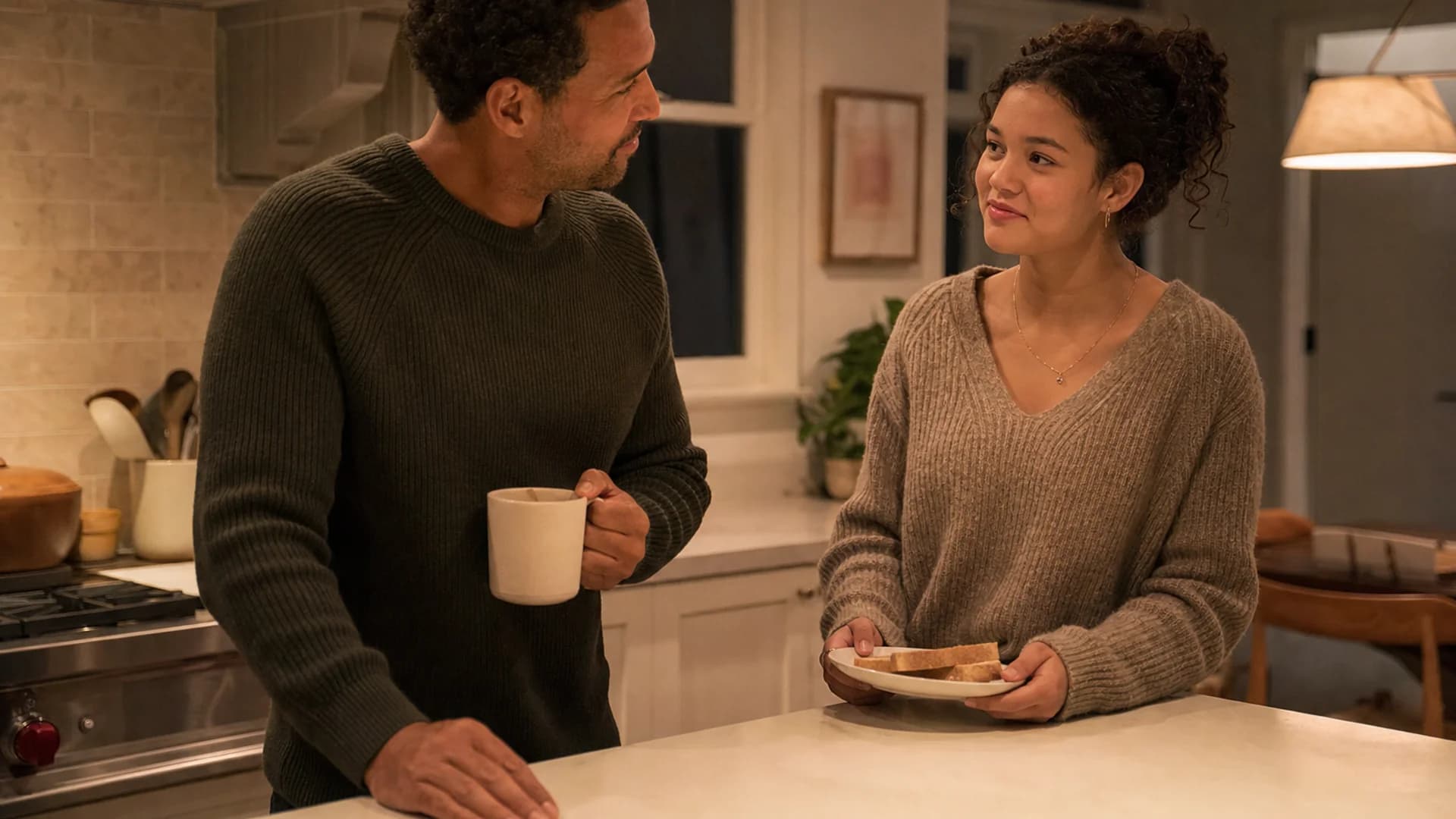
75 Conversation Starters for Teenagers That Don’t Feel Like an Interview
Skip the interrogation vibe. These 75 teen prompts climb from easy warm-ups to deeper check-ins—so you ask what the moment can hold.
Read next
Why Kids Give One-Word Answers — And What To Ask Instead
“Fine” is often the easiest answer to a question that feels too big. Learn what to ask instead when broad check-ins keep falling flat.
Read next
Why Car Rides Help Kids Talk — And What To Ask When You’re Side By Side
Side-by-side beats face-to-face for a lot of kids. See why the car makes talking easier—and what to ask without turning the drive into a quiz.
Read next
Why Kids Open Up At Bedtime
When the day finally slows down, kids often have more to say. Use bedtime wisely—with gentle prompts that protect sleep and connection.
Read next
35 Bonding Activities for Families, Matched to the Moment You’re Actually In
When conversation feels forced, start with shared action instead. Find 35 low-pressure ways to reconnect that fit the energy you actually have today.
Read next
How To Build Trust With Your Child One Small Conversation At A Time
Trust is built in tiny everyday moments. Learn the small responses that make kids feel safe enough to tell you more next time.
Read next